Ancient & Historical Food Preservation: Roman Garum Autolysis, Incan Chuño Freeze-Drying, and Celtic Bog Butter

In our contemporary world of digital sensors, automated retorts, and ultra-deep freeze chains, modern food preservers often view food security as a triumph of recent industrial technology. Yet every thermodynamic principle, osmotic barrier, and microbiological threshold utilized in modern food preservation was discovered, perfected, and deployed millennia ago by ancient civilizations fighting for survival across … Read more
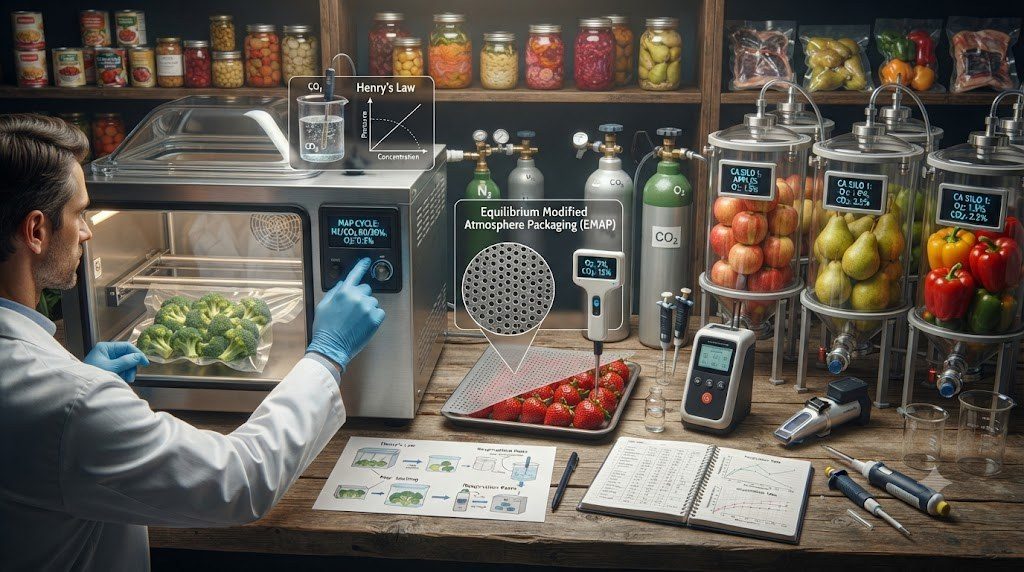
Modified Atmosphere Packaging (MAP): Henry’s Law CO2 Dissolution, Laser Micro-Perforated EMAP, and CA Storage Silos

Walk through any modern fresh food distribution center, gourmet grocery market, or international shipping terminal and you will observe a quiet miracle of modern post-harvest biochemistry: pre-cut salad greens that remain crisp, green, and completely unbrowned for three weeks, fresh raw salmon fillets that retain ocean-fresh firmness after 14 days without freezing, and artisan bakery … Read more

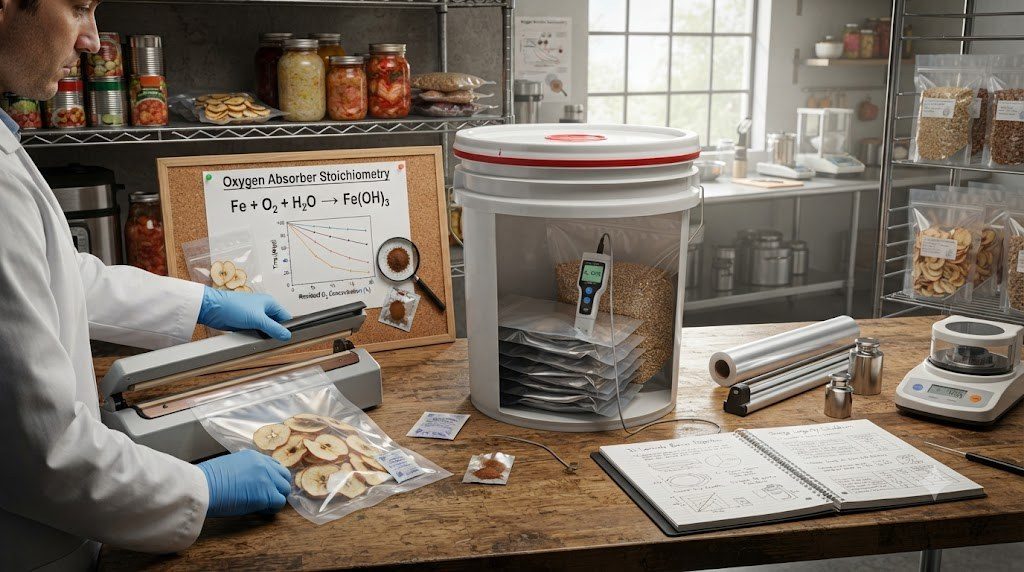
Hermetic Mylar Packaging: Aluminum Tri-Laminates, Ferrous Oxygen Absorber Stoichiometry, and HDPE Bucket Defense

In modern long-term disaster preparedness, agricultural seed banking, and humanitarian food reserves, the gold standard technology for achieving multi-decade shelf stability (20 to 30+ years) for dry staple foods is Hermetic Barrier Packaging utilizing High-Barrier Aluminum Foil Mylar Bags, Active Ferrous Carbonate Oxygen Absorbers, and Synthetic Molecular Sieve Desiccants. While home cooks often assume that … Read more

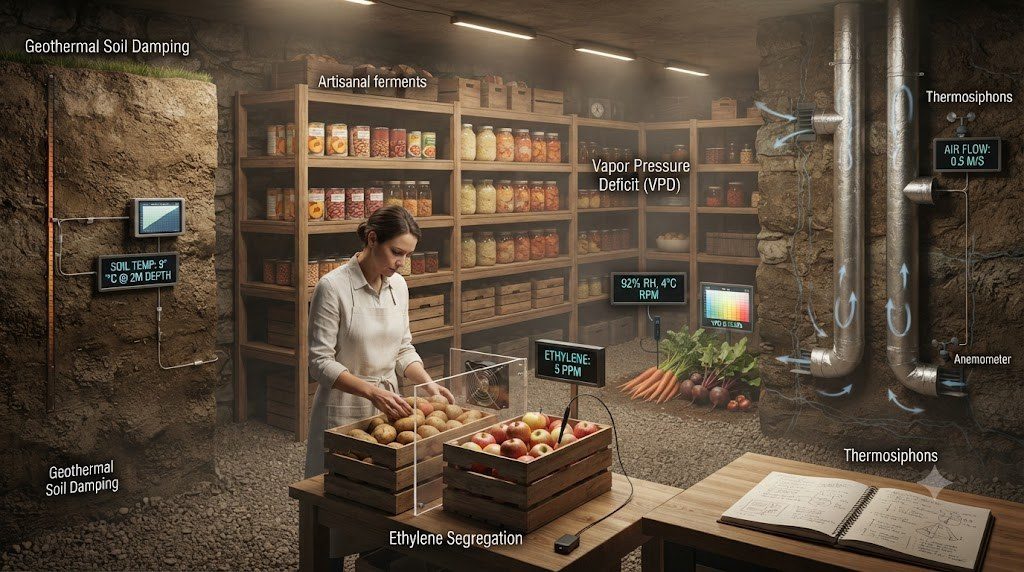
Root Cellar Engineering: Geothermal Soil Damping, Vapor Pressure Deficit (VPD), Ethylene Segregation, and Thermosiphons

In an era dominated by grid-connected mechanical vapor-compression refrigeration, the Earth-Sheltered Root Cellar stands as the ultimate triumph of passive thermodynamic and agricultural architecture. For centuries before electrical power grids existed, homesteads, farmsteads, and monasteries preserved metric tons of fresh autumn root vegetables, brassicas, pomes, and squashes across grueling winters using zero fossil fuels or … Read more

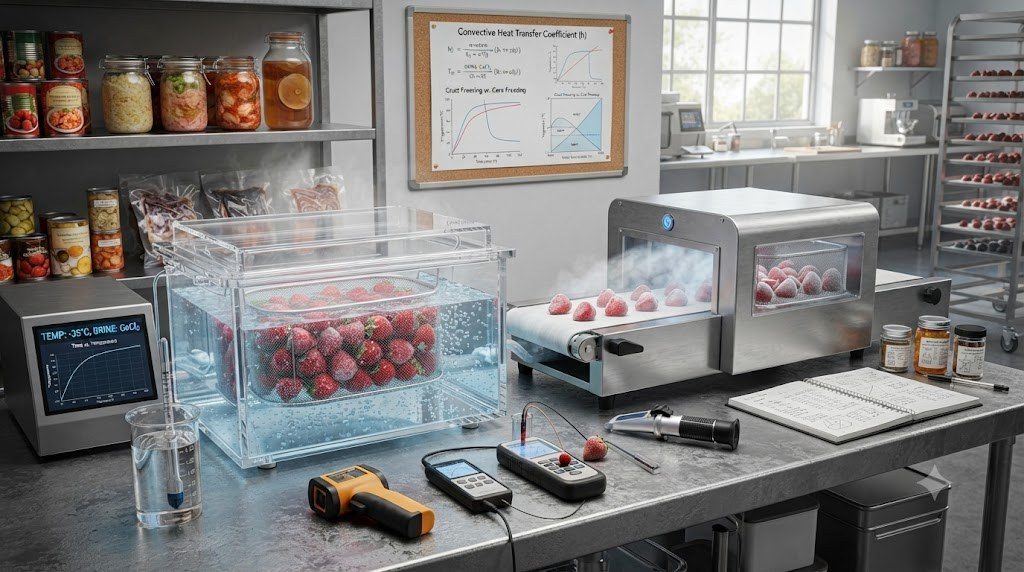
Liquid Immersion Freezing & Blast Tunnels: Secondary Eutectic Brines, Convective Heat Transfer, and Crust Freezing

In standard food freezing, heat is transferred out of the food matrix into circulating refrigerated air—a gas medium with a low physical density and notoriously poor thermal conductivity ($k_{air} \approx 0.024\text{ W/m}\cdot\text{K}$). Consequently, conventional cold storage freezing is painfully slow, requiring 8 to 24 hours to freeze large muscle cuts or poultry to their core. … Read more

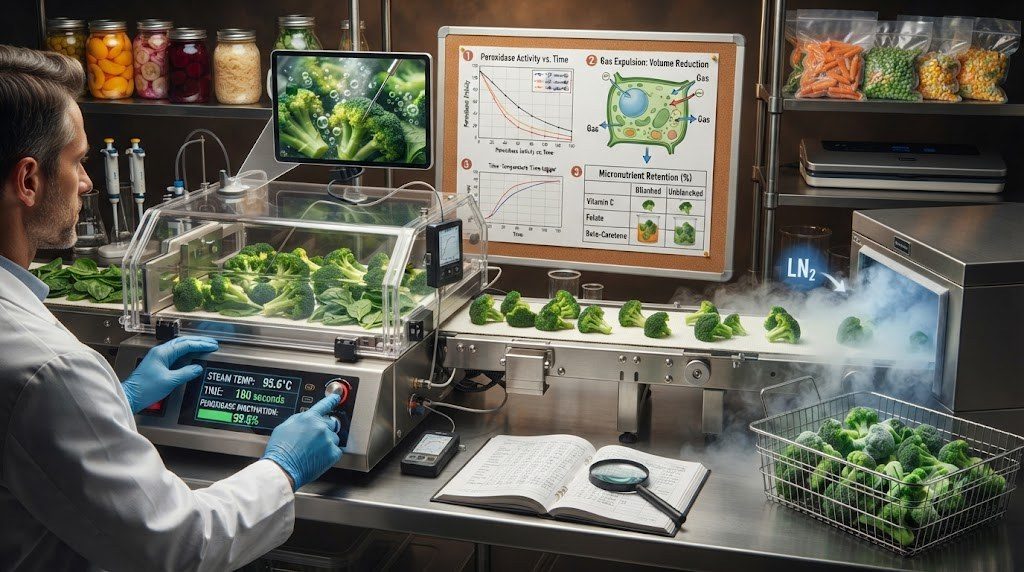
Thermal Blanching Kinetics Before Freezing: Peroxidase Inactivation, Gas Expulsion, and Micronutrient Retention

In household and industrial vegetable freezing, a widespread misconception persists that freezing produces high-quality vegetables simply by placing freshly picked raw produce directly into the freezer. In reality, freezing raw unblanched garden vegetables—such as green peas, green beans, sweet corn, broccoli, and carrots—invariably results in bitter disappointment after 8 to 12 weeks of frozen storage: … Read more

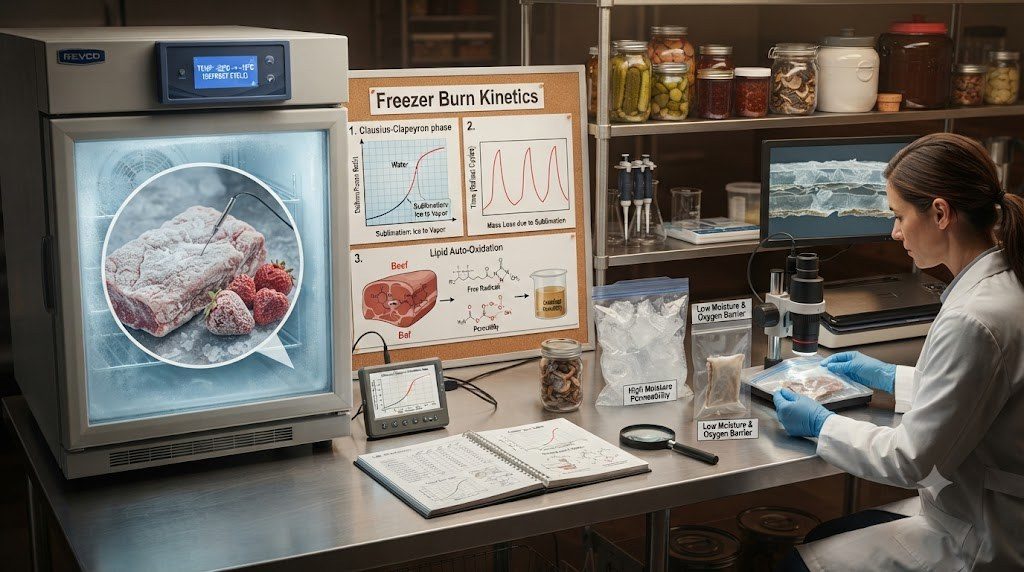
Freezer Burn Physics: Clausius-Clapeyron Sublimation, Defrost Cycling, Lipid Auto-Oxidation, and Barrier Films

Open any unmanaged home freezer and you will inevitably discover the tell-tale visual signatures of food preservation degradation: a once-prime ribeye steak coated in dry, leathery, grayish-white patches, or a bag of frozen berries encrusted with heavy white snow crystals while the fruit beneath shrivels into dry husks. This ubiquitous deterioration is colloquially known as … Read more

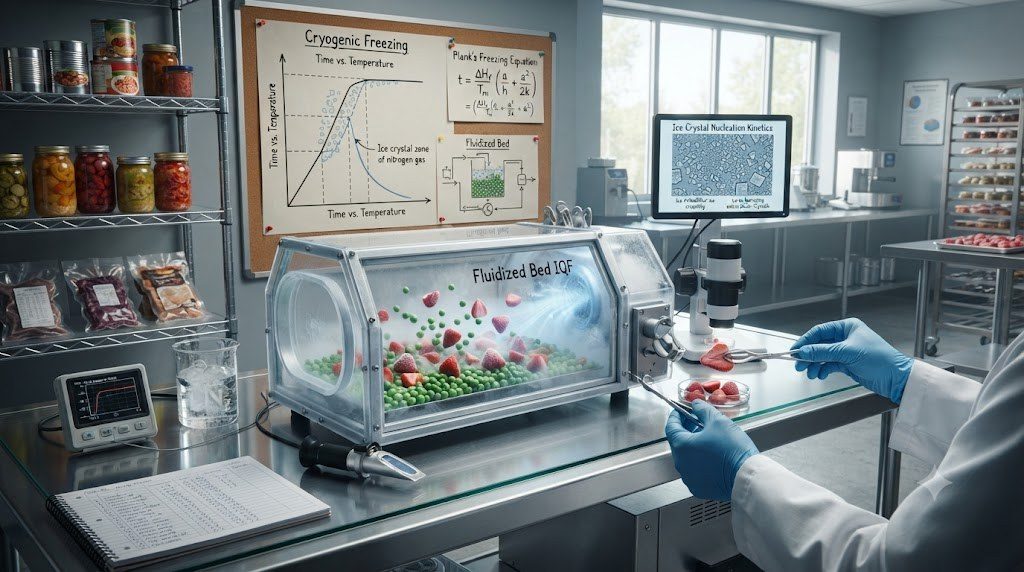
Cryogenic Food Freezing: Ice Crystal Nucleation Kinetics, Plank’s Freezing Equation, and Fluidized Bed IQF

In the physical spectrum of food preservation technologies, Freezing is unique: unlike canning (which applies lethal thermal energy to destroy cells) or dehydration (which strips away water molecules), freezing preserves food by removing thermal kinetic energy, immobilizing liquid water into solid ice crystals ($H_2O$ ice Ih). By lowering product temperatures below $0^\circ\text{C}$ (and maintaining international … Read more

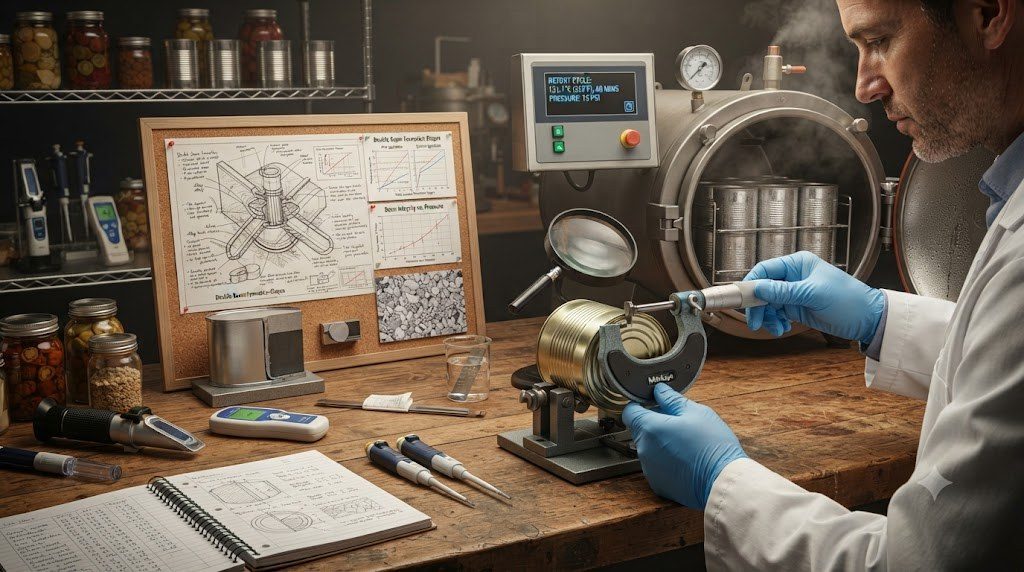
Tin Can Sealing & Double-Seam Integrity: Seam Micrometer Teardowns, Electrolytic Tinplate, and Industrial Retorts

While glass Mason jars remain the beloved standard of home homesteaders and small-batch preservers, global commercial food security rests squarely upon a different container: the Hermetic Tinplate Steel Can processed inside high-temperature industrial Steam Retorts. Invented by Peter Durand in 1810 and mechanized over two centuries of metallurgical and mechanical engineering, the modern three-piece and … Read more

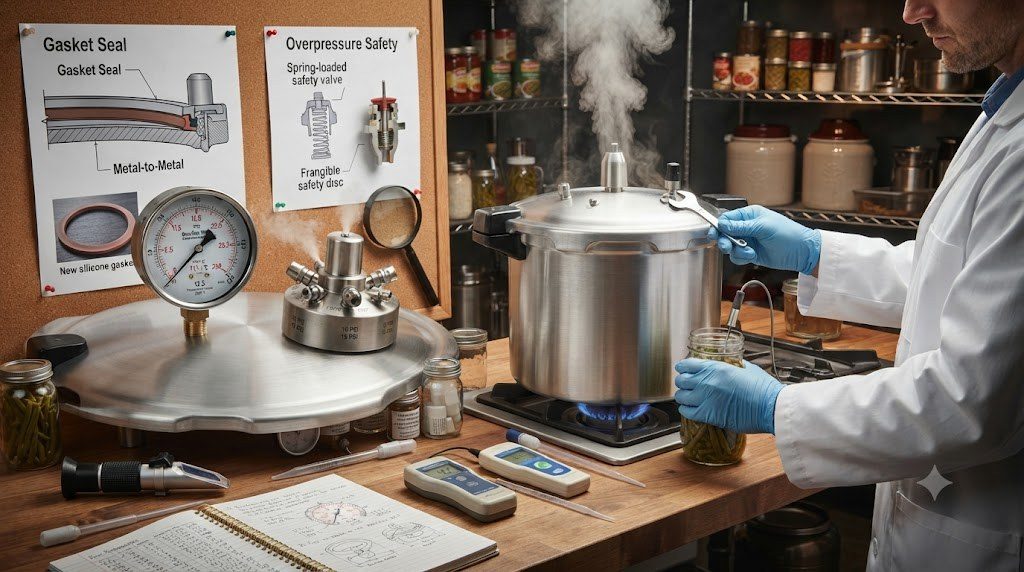
Pressure Canner Engineering: Bourdon Dial Calibration, Weighted Regulators, Gasket Seals, and Overpressure Safety

In thermal food processing, a Pressure Canner is not merely an oversized stockpot; it is a heavy-duty, ASME-rated thermodynamic pressure vessel designed to operate at internal gauge pressures up to $15\text{ to }20\text{ PSI}$ ($103\text{ to }138\text{ kPa}$) and temperatures exceeding $121^\circ\text{C}$ ($250^\circ\text{F}$). Because it harnesses the explosive energy of pressurized saturated steam to achieve … Read more